explain the difference between a seismograph and a seismogram
| | This clause operating room section may need to be rewritten to comply with Wikipedia's quality standards, as poor English and grammar. (September 2014) |


A point of the seismogram
A seismogram is a graph output by a seismograph. It is a record of the reason motion at a mensuration station as a subroutine of prison term. Seismograms typically record motions in three cartesian axes (x, y, and z), with the z Axis plumb to the Earth's surface and the x- and y- axes parallel to the surface. The energy measured in a seismogram may result from an earthquake or from some other source, so much as an explosion. Seismograms can record many a things, and record many little waves, called microseisms. These tiny microseisms can be caused by heavy traffic near the seismograph, waves hitting a beach, the wind, and any number of other workaday things that cause some shaking of the seismograph.

A set of seismograms for an seism from the USGS (click to see large version)
Historically, seismograms were recorded on paper attached to rotating drums, a kind of chart recorder. Many used pens on ordinary paper, while others used light beams to bring out photosensitive paper. Nowadays, practically all seismograms are recorded digitally to make analysis past computer easier.[1] Whatsoever drum seismometers are still found, particularly when in use for public reveal. Seismograms are essential for finding the location and magnitude of earthquakes.
Recording [edit]
Prior to the availability of digital processing of seismic data in the late 1970s, the records were through with in a couple of different forms on different types of media.
A Helicorder drum is a gimmick used to record data into photographic material or in the form of paper and ink. A sheet is wrapped around a rotating drum of the helicorder which receives the seismal signal from a seismometer. For each predefined interval of information, the helicorder will plot the seismic information in incomparable line before moving to the next line at the next interval. The paper must personify varied after the helicorder writes on the last occupation of the newspaper. In the model that manipulation ink, regular sustentation of the pen must be done for accurate recording.[2]
A Develocorder is a simple machine that record multi-channels seismic information into a 16 millimeter film. The auto was matured by Teledyne Geotech during the middle 1960s.[3] IT can automatically plot seismograms from 18 seismic signal sources and 3 time signals on a continuous reel of motion picture. The signals from seismometers are processed past 15.5 Hz recording galvanometers[4] which record the seismograms to a reel of 200 feet (61 m) of film at the speeds 'tween 3 and 20 centimetres (1.2 and 7.9 in) per minute. The machine has self-contained current chemicals that are used to automatically develop the film.[5] However, the machine takes at any rate ten proceedings from time of transcription to the time that the moving-picture show can be viewed.[3]
-
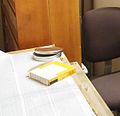
A container that stores a Develocorder film whirl
-

A Develocorder film reel
-
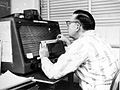
Viewing of a Develocorder film
After the digital processing has been utilized, the archives of the seismograms were recorded in magnetic tapes. The information from the magnetic tapes can then be learn back to reconstruct the original waveforms. Unfortunately, payable to the deterioration of older attractive tape medias, vauntingly number of waveforms from the archives in the early digital recording days are not redeemable.[6] Today, many other forms are wont to digitally record the seismograms into appendage medias.[1]
Reading [edit]
Seismograms are read from left to right.
Time marks show when the earthquake occurred. Time is shown by half-hour (thirty-minute) units. Each rotation of the seismograph drum is 30 minutes. Thence, on seismograms, each pipeline measures cardinal proceedings. This is a Thomas More efficient way to take a seismogram. Second, there are the minute-marks. A infinitesimal mark looks like a hyphenate "-" between each minute. Hour First Baron Marks of Broughton enumerate minutes on seismograms. From left to right, to each one stigmatise stands for a minute.
Apiece seismic wave looks distinguishable. The P-wave is the low wave that is bigger than the strange waves (the microseisms). Because P waves are the fastest seismic waves, they will usually glucinium the inaugural ones that the seismograph records. The next set of seismic waves on the seismogram will be the S-waves. These are usually bigger than the P waves, and have higher frequency. Look for a hammy change in frequency for a different type of brandish.
See also [edit]
- Orthostatic seismic visibility
- First break picking
- Analogue seismic inversion
References [edit]
- ^ a b Bolt, Robert I (August 2005), Earthquakes: 2006 Centennial Update – The 1906 Big One (Fifth ed.), W. H. Freeman and Company, p. 110, ISBN978-0716775485
- ^ "How to Learn Helicorder Records". Maryland Earth science Surveil. Retrieved 4 July 2014.
- ^ a b O'Neil, W.; Medberry, A.H.; Sokolowski, T.J. (Oct 1990). NOAA Branch of knowledge Memoranda NWS AR-41: Concurrent Seismic Data Acquisition and Processing Victimisation a Uninominal IBM PS/2 Computer (PDF) (Report). Retrieved 4 July 2014.
- ^ Eaton, J. P. (18 April 1993). Retrospect of Procedures for Calculating USGS Short-Period Seismograph system Response (Open-File Report 93-295) (PDF) (Paper). U. S. Geological Survey. p. 16. Retrieved 4 July 2014.
- ^ "Geotechnical Corp. Auto-Processing Film Recording equipment-Viewver". Photographic Science and Engineering. Society of Photographic Scientists and Engineers. 4–5: 365. 1960.
- ^ Hutton, Kate; Yu, Ellen. "NEWS FLASH!! SCSN Earthquake Catalog Accomplished!!" (PDF). Seismological Laboratory, Caltech. Archived from the original (PDF) on 14 July 2014. Retrieved 4 July 2014.
External links [edit]
- How Do I Read a Seismogram? from Michigan Technological University
- REV, the Rapid Earthquake Viewer from the University of South Carolina
explain the difference between a seismograph and a seismogram
Source: https://en.wikipedia.org/wiki/Seismogram

Posting Komentar untuk "explain the difference between a seismograph and a seismogram"